Our Team Tests Multi-Machine Coordination for Chili Harvesting in Xinjiang
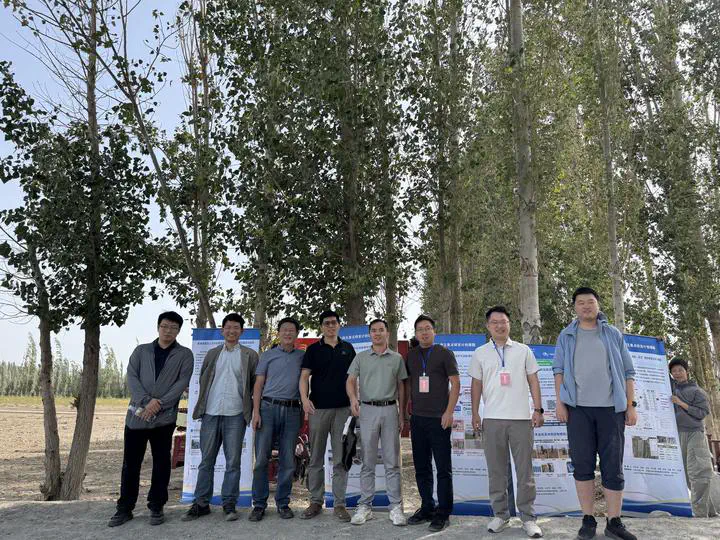
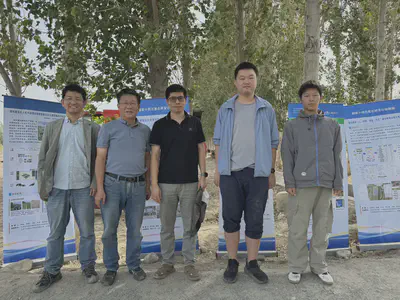
From September 20 to 21, our team traveled to Heshuo County in Bayingolin, Xinjiang, to attend the 2026 Xinjiang (Bayingolin–Heshuo) Processing Chili Industry Development Conference and Production–Sales Matchmaking Event. During the visit, we conducted field tests of our multi-machine coordination system at a chili production base in Suhate Township.
The tests formed part of an on-site demonstration and evaluation for the National Key R&D Program project on key technologies and intelligent machinery for industrialized agriculture. Focusing on coordinated machinery operations in open-field vegetable production, we evaluated the feasibility and performance of our cloud–edge–device scheduling approach under real chili-harvesting conditions.
Connecting Agricultural Machines Through Drivers’ Phones
Most agricultural machines are still operated manually, and coordination between machines largely depends on verbal communication and driver experience. Conventional intelligent scheduling solutions often require additional communication and control equipment to be installed on each machine, increasing deployment costs and making rapid adoption difficult.
To address this challenge, we use the driver’s smartphone as the task interface. The scheduling system generates assignments in the cloud and sends them directly to each driver’s phone. Drivers then follow the instructions to perform harvesting, transport, and relocation tasks. The method works with existing manually driven machines and requires no additional onboard hardware.

Four Machines Tested Under Real Field Conditions
The field trial involved two chili harvesters and two transport vehicles. Based on harvesting progress, vehicle locations, and transport demand, the system dynamically assigned tasks and coordinated the connection between harvesting and transport operations through the drivers’ phones.
Compared with conventional manual scheduling, the cloud–edge–device coordination system achieved:
- more than 30% savings in machinery operating time;
- an 11% reduction in energy consumption; and
- deployment without additional onboard equipment, reducing the cost of intelligent retrofitting and adoption.
The trial demonstrated the system’s stability in a real production environment. It also showed that low-cost digital scheduling can improve multi-machine coordination without changing how existing machinery is driven.
Bringing Agricultural Foundation Models Closer to Open-Field Production
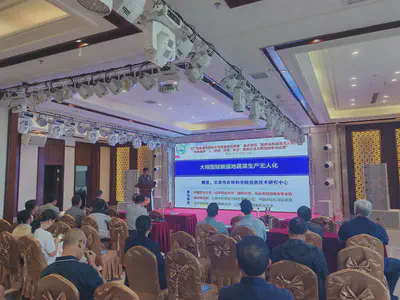
During the event, the open-field vegetable foundation-model project team presented recent progress in applying artificial intelligence to machinery–agronomy adaptation, precise management of water, fertilizer, and pesticides, and intelligent agricultural equipment. Professor Ya Xiong, project leader and head of our research team, introduced the team’s approach and results in using foundation models to support open-field vegetable production.
The project’s independently developed steady-state system for mounting multiple implements improved the consistency of tillage-depth and planting-depth control, helping crops maintain more uniform growth from the seedling stage through harvest. Related technologies increased fully automated transplanting rates to over 90% for cabbage and over 95% for processing chili. They also enabled unmanned harvesting of cabbage, white radish, and processing chili, reducing labor costs by approximately CNY 400 per mu for cabbage and more than CNY 700 per mu for white radish.
For our team, the Xinjiang field trial was an important step in moving scheduling algorithms from controlled experiments into real agricultural production. We will continue studying multi-machine coordination, agricultural foundation models, and their integration with intelligent machinery to improve adaptability under complex operating conditions and deliver practical, lower-cost solutions for open-field vegetable production.